
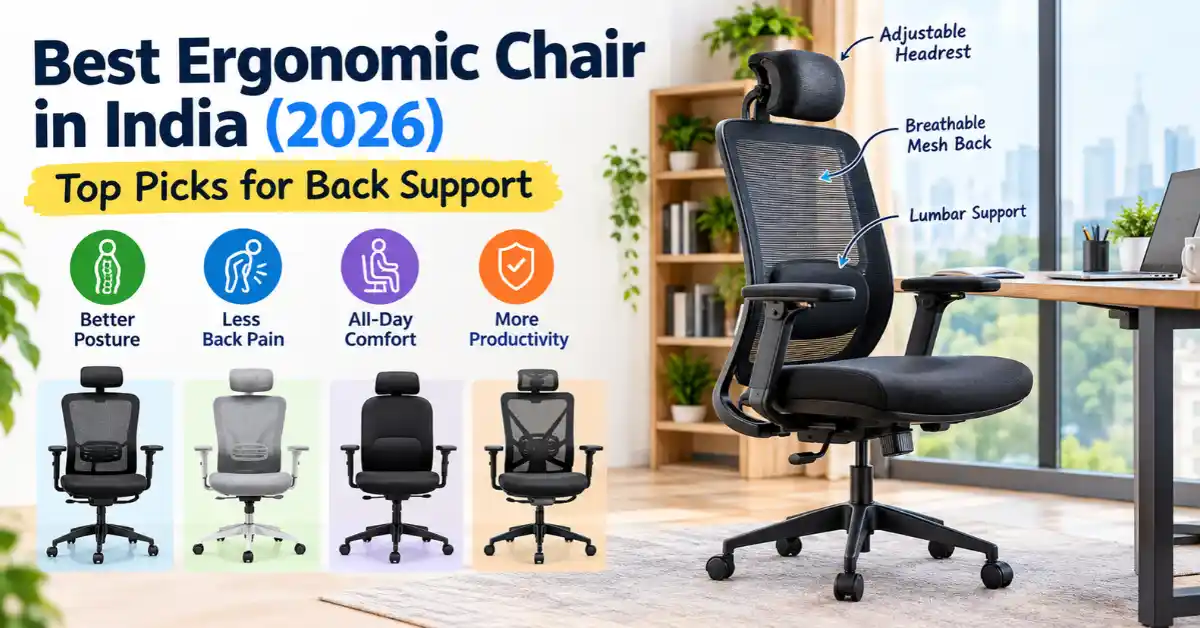
The best ergonomic chair in India for most work-from-home professionals sitting 6 to 10 hours daily combines adjustable lumbar support, a breathable full-mesh back, 2D/3D adjustable armrests, and a Class-4 hydraulic gas lift.
- Best Overall Value (₹8,000 – ₹15,000): High-back mesh chairs with independent lumbar height adjustments and synchro-tilt mechanisms, such as models from Green Soul or Featherlite.
- Best for Pressure Relief (₹10,000 – ₹18,000): Patented gel-polymer grid chairs, such as The Sleep Company SmartGRID series, that cushion sit-bones while keeping your spine aligned.
- Best High-End / Enterprise (₹15,000 – ₹35,000+): Enterprise-grade ergonomic chairs with seat sliders, dynamic weight-sensing recline, and die-cast aluminum bases, such as the Featherlite Optima or Liberate series.
Key Takeaways
- Choose Breathable Mesh: In hot and humid Indian weather, high-density polyester or nylon mesh works much better than PU leatherette, which traps heat and makes you sweat.
- Check Hardware Standards: Make sure the chair uses a Class-4 gas lift certified by BIFMA X5.1. This ensures smooth height adjustment and supports weights up to 125–150 kg.
- Lumbar Support is Essential: Look for lumbar systems that adjust vertically and in depth so the support fits directly into your lower back curve ($L1-L5$ vertebrae).
- Seat Depth Matters: Taller people or those with longer thighs need a seat slider mechanism to prevent leg numbness and pressure behind the knees.
- Budget Realities: True ergonomic chairs start around ₹7,000–₹9,000. Chairs under ₹5,000 offer basic seating but lack the adjustability needed for long work hours.
Introduction
Working 8 to 12 hours a day on an unsupportive chair leads to poor posture, lower back stiffness, shoulder tension, and trouble focusing. In India, the rise in remote work, IT jobs, and long study hours makes a good ergonomic chair an important investment for your health.
However, choosing a chair can be tricky. Online stores are full of basic task chairs labeled as “ergonomic” even though they lack key adjustments. Also, Indian weather—from hot summers to heavy monsoons—requires specific materials to keep you comfortable and make the chair last.
This guide explains what makes a desk chair truly ergonomic, looks at top chair categories in India across different budgets, and helps you pick the right setup for your workspace.
What Makes a Chair Truly Ergonomic?
An ergonomic chair is not just about thick cushions or racing-seat shapes. It is designed to support your natural posture, maintain the natural S-curve of your spine, and fit different body shapes.
| Ergonomic Chair Feature | Purpose and Benefits |
|---|---|
| Adjustable Headrest | Supports the neck and cervical spine (C1–C7) for better comfort. |
| Breathable Mesh Back | Improves airflow to keep you cool and helps maintain proper spinal alignment. |
| Adjustable Lumbar Support | Supports the natural curve of the lower back (L1–L5) and helps reduce slouching. |
| 3D/4D Adjustable Armrests | Help keep elbows at around 90° and reduce strain on the shoulders. |
| Moulded Foam or Grid Seat | Distributes body weight more evenly and reduces pressure points. |
| Seat Depth Slider | Allows proper thigh support while leaving a gap of around 2–3 fingers behind the knees. |
| Class 4 Gas Lift (BIFMA-Compliant) | Enables smooth seat-height adjustment and provides reliable support when properly rated and certified. |
1. Lumbar Support System
- Your lower back curves inward naturally. Sitting for a long time can flatten this curve, straining your muscles and spine discs. A good chair has adjustable lumbar support that presses gently against your lower back ($L1-L5$ area) to keep your spine in its natural shape.
2. Synchro-Tilt Recline Mechanism
- Basic tilt mechanisms tilt the seat and backrest together at the same speed, which lifts your feet off the floor when you lean back. A synchro-tilt mechanism moves the backrest twice as fast as the seat pan, for example, tilting the back $10^\circ$ while the seat tilts $5^\circ$. This keeps your feet flat on the floor and your body open while you move.
3. Seat Pan & Depth Adjustment (Seat Slider)
- The seat should use high-density molded foam or supportive mesh with a waterfall front edge that curves downward. A seat slider lets you move the seat forward or backward. You should keep 2 to 3 fingers of space between the back of your knees and the seat edge to maintain good blood flow.
4. Multi-Directional Armrests
Fixed armrests force your shoulders into an awkward position.
- 2D Armrests: Adjust for height and depth.
- 3D Armrests: Adjust for height, depth, and angle.
- 4D Armrests: Adjust for height, depth, angle, and width. Good armrests let your elbows rest comfortably at a $90^\circ$ to $100^\circ$ angle, reducing shoulder strain.
5. Heavy-Duty Gas Lift & Wheel Base
- The gas lift cylinder controls the height of your seat. Class-4 gas lifts are thicker, sealed with nitrogen, and support higher weights (up to 150 kg) better than Class-2 or Class-3 cylinders. A strong 5-prong nylon or metal base with dual-wheel castors helps you roll smoothly on tiles, wood floors, or carpets.
The Indian Context: Climate, Sizing, and Materials
Buying an office chair in India means thinking about local weather and body types, which standard international reviews often miss.
Material Choice: Mesh vs. PU Leatherette vs. SmartGRID
| Feature | High-Density Nylon Mesh | SmartGRID Polymer | PU Leatherette |
| Breathability | Excellent (Maximum air flow) | Good (Open channel design) | Poor (Traps body heat) |
| Use in Non-AC Rooms | Ideal for Indian summers | Good | Not suitable (Causes sweating) |
| Durability / Sag Resistance | High (if high-grade nylon) | Very High (Does not flatten) | Medium (Cracks and peels over time) |
| Cleaning & Dust Care | Easy (Vacuum or wipe) | Easy (Wipeable cover) | Moderate (Prone to moisture damage) |
| Seating Feel | Suspended, firm support | Adapting, pressure-relieving | Soft initial cushion feel |
Climate Tip: For rooms without air conditioning or in warm regions of India, full-mesh chairs or open grid designs are much better than synthetic leatherette. Leatherette traps body heat quickly and can peel when exposed to sweat over time.
Ergonomics for Indian Body Types
Average heights in India differ from European or North American standards. Taller people (5’10” and above) should look for high-back chairs with adjustable headrests and seat sliders so their thighs do not hang off the edge. Shorter people (under 5’4″) should check the lowest seat height ($42\text{ cm} – 45\text{ cm}$) to make sure their feet rest flat on the floor without needing a footrest.
Top Ergonomic Chair Categories in India
Ergonomic chairs in India come in different price ranges. Here is a breakdown to help you match your budget and workspace needs.
| Chair Category | Price Range | Key Features |
|---|---|---|
| Premium & Executive | ₹30,000 and above | Aluminium base, advanced synchronous tilt mechanism, and 4D adjustable armrests |
| Professional & Heavy-Duty | ₹15,000–₹30,000 | Sliding seat adjustment, Class 4 gas lift, and 3D/4D adjustable armrests |
| Value & Performance | ₹6,000–₹15,000 | High-back mesh design, 2D/3D adjustable armrests, and adjustable lumbar support |
| Entry-Level & Budget | Below ₹6,000 | Basic mesh construction, fixed or 2D adjustable armrests, and a medium- to high-back design |
Tier 1: Entry-Level / Budget Segment (Under ₹6,000)

Best for students, light use (2–4 hours daily), or secondary study desks.
- Key Features: Mid-back or basic high-back designs, single-lock tilt, fixed or 2D armrests, standard foam, and Class-3 or basic Class-4 gas lifts.
- Pros: Low price, compact size, easy to assemble.
- Cons: No seat sliders or advanced lumbar tuning; foam cushioning wears out faster with heavy use.
- Popular Brands/Models: Entry models from CellBell (such as the C100 series), Wakefit Orion/Apollo entry tiers, and budget mesh chairs.
Tier 2: Value & Performance Segment (₹6,000 – ₹15,000)

The best choice for most work-from-home professionals, coders, and office workers sitting 6 to 9 hours a day.
- Key Features: High-back breathable mesh, height-adjustable padded lumbar support, 2D/3D armrests, multi-position synchro-tilt lock, strong nylon bases, and certified Class-4 gas lifts.
- Pros: Great posture support, keeps you cool in summer, solid build, and fair pricing.
- Cons: Seat depth adjustments are rare in the lower price range of this tier.
- Popular Brands/Models: Green Soul (Jupiter Superb / Zodiac Pro series), The Sleep Company (Onyx / SmartGRID entry series), Wakefit (Gravita High Back series).
Tier 3: Professional & Heavy-Duty Segment (₹15,000 – ₹30,000)

Built for people with chronic back stiffness, sciatica, or those sitting 9 to 12+ hours daily.
- Key Features: Full-body Korean or Taiwanese mesh, built-in seat depth sliders, 3D/4D armrests, self-adjusting weight-sensing tilt, and reinforced metal frames.
- Pros: Excellent spine support, highly adjustable, lasts 5 to 10 years, and gives great thigh clearance.
- Cons: Costs more upfront and takes time to set up properly.
- Popular Brands/Models: Featherlite (Optima / Liberate series), Green Soul premium models, Drogo high-tier series, and office-grade brands.
Tier 4: Luxury & Imported Executive Segment (₹30,000+)

Made for company executives, design studios, or anyone wanting top-tier ergonomic engineering.
- Key Features: Cast aluminum bases, polished chrome details, high-end mesh, multi-axis posture adaptation, and warranties of 10 years or more.
- Pros: Holds good resale value, premium materials, and top-tier comfort.
- Cons: High cost with smaller comfort gains compared to mid-tier professional chairs.
- Popular Brands/Models: Herman Miller (Aeron / Sayl), Steelcase (Gesture / Think), Humanscale, and high-end Featherlite executive series.
Technical Comparison Matrix
| Specification Feature | Budget (Under ₹6,000) | Value Tier (₹6,000–₹15,000) | Professional Tier (₹15,000–₹30,000) | Luxury Tier (₹30,000+) |
| Target Daily Use | 2–4 Hours | 6–8 Hours | 8–12+ Hours | 10+ Hours |
| Lumbar Support | Fixed cushion bump | Height Adjustable Pad | Dynamic 2D/3D Tracking | Dynamic Auto-Conforming |
| Armrest Flexibility | Fixed or 1D (Height) | 2D / 3D (Height + Depth) | 3D / 4D Full Pivot | 4D Ultra-Adjustable |
| Seat Depth Slider | No | Rare (Upper end only) | Included | Included |
| Gas Lift Rating | Class 2 / Class 3 | Class 4 Heavy-Duty | Class 4 Heavy-Duty | Heavy-Duty Certified |
| Recline Mechanism | Center-Tilt (Single lock) | Synchro-Tilt (Multi-lock) | Advanced Synchro / Multi-Angle | Weight-Sensing Auto Synchro |
| Expected Lifespan | 1–2 Years | 4–6 Years | 7–10 Years | 10–12+ Years |
Anatomy of an Ergonomic Chair: Hardware Inspection Checklist
When checking or unboxing an ergonomic chair, look closely at these core parts to ensure safety and durability:
| Ergonomic Chair Component | Description / Function |
|---|---|
| Adjustable Headrest | Supports the neck and cervical spine. |
| Mesh Backrest with Lumbar Pad | Improves airflow and supports the lower back. |
| 3D Adjustable Armrests (Left and Right) | Allow armrest adjustments for better arm and shoulder comfort. |
| Seat Cushion / Slider Plate | Provides seating comfort and allows seat-depth adjustment. |
| Synchronous Tilt Control Mechanism | Coordinates seat and backrest movement when reclining. |
| Class 4 BIFMA Gas Lift Cylinder | Enables smooth seat-height adjustment. |
| Five-Star Nylon / Aluminium Base | Provides stability and supports the chair structure. |
| Five Twin-Wheel PU Castors | Allow smooth movement across suitable floor surfaces. |
- Gas Lift Cylinder: Check that the cylinder is stamped as Class 4 (tested to the BIFMA X5.1 standard). Lower-grade lifts wear out faster and lose pressure over time.
- Wheel Base Material: Look for glass-fiber reinforced nylon or die-cast metal for strong stability. Avoid cheap, unreinforced plastic bases.
- Seat Cushion Density: If you choose a foam seat, look for cold-cured molded foam with a density of $45-50\text{ kg/m}^3$ or higher. Cut foam flattens out quickly with daily use.
- Castor Wheels: Polyurethane (PU)-coated dual wheels roll quietly and protect tile, marble, or wood floors without leaving scratches.
How to Set Up Your Chair for Optimal Ergonomic Posture
Buying a great chair is only the first step. Setting it up correctly for your body is what really protects your back. Follow these simple adjustment steps:
| Step | Ergonomic Chair Adjustment | How to Set It Correctly |
|---|---|---|
| 1 | Feet Flat on the Floor | Adjust the seat height so your feet rest flat on the floor and your knees are bent at approximately 90°. |
| 2 | Lumbar Support Alignment | Position the lumbar support to follow the natural curve of your lower back. |
| 3 | Seat Depth Adjustment | Leave a gap of around 2–3 fingers between the front edge of the seat and the back of your knees. |
| 4 | Armrest Alignment | Adjust the armrests to support your forearms, keeping your elbows at approximately 90° and your shoulders relaxed. |
| 5 | Headrest Placement | Position the headrest to support the base of your skull comfortably while keeping your neck relaxed. |
- Set Seat Height: Raise or lower the seat until your feet rest flat on the floor, with your knees bent at a $90^\circ$ angle and your thighs parallel to the floor.
- Position the Lumbar Support: Move the lumbar support up or down so it fits snugly into the small of your back, supporting your spine without pushing you forward.
- Adjust Seat Depth: If your chair has a seat slider, move the seat so your back touches the backrest while leaving a 2-to-3-finger gap between the seat edge and your knees.
- Align Armrests with Desk: Set the armrest height so your forearms rest naturally on your desk with your shoulders relaxed and elbows bent between $90^\circ$ and $100^\circ$.
- Set Headrest Position: Position the headrest to support the curve of your neck when you lean back, making sure it does not push your head forward when you type.
Maintenance & Care Tips for Indian Workspaces
To help your chair last longer in Indian weather conditions:
- Clean Dust from Wheels: Hair and dust get stuck around the wheels. Clean the wheel housings every two months using a small brush or air duster to keep them rolling smoothly.
- Vacuum the Mesh: Dust collects inside the mesh weave. Run a vacuum cleaner with a soft brush attachment over the backrest once a month.
- Protect from Moisture: During the humid monsoon months, keep the metal base and levers dry to prevent rust.
- Tighten Bolts Every Year: Sitting and leaning back creates small vibrations that loosen hex bolts over time. Tighten all under-seat bolts once a year using an Allen key.
READ ALSO:-Best Tablets Under ₹50,000 in India (2026): Top Picks and Buying Guide
10. FAQ
1. Is a mesh chair better than a leatherette chair in India?
Yes. Breathable mesh works much better in Indian weather. Synthetic leatherette (PU leather) traps body heat and sweat, making you sticky and causing the material to peel in warm rooms. High-density mesh lets air flow freely, keeping your back cool during long work hours.
2. What is a Class-4 gas lift, and why is it important?
A Class-4 gas lift is a heavy-duty hydraulic cylinder tested to BIFMA standards to hold higher weights (up to 150 kg) through daily use. It offers smoother height adjustments and better safety than thinner Class-2 or Class-3 cylinders.
3. How much should I spend on a good ergonomic chair in India?
For work shifts of 6 to 10 hours a day, a budget of ₹8,000 to ₹18,000 is ideal. Chairs in this range offer adjustable lumbar support, synchro-tilt mechanisms, 2D or 3D armrests, and certified gas lifts. Chairs under ₹5,000 do not have enough adjustments for long-term back support.
4. What is a seat slider mechanism?
A seat slider lets you move the seat cushion forward or backward independently of the backrest. This helps fit your thigh length, keeping your back supported while maintaining good blood circulation behind your knees.
5. Can an ergonomic chair cure existing lower back pain?
An ergonomic chair helps relieve lower back strain by keeping your spine in its natural alignment ($L1-L5$) and spreading out your weight. However, it is a tool for support and prevention rather than a medical cure. Good posture, regular breaks to stretch, and core exercises are still necessary.
6. What warranty should I expect on an ergonomic chair in India?
Good brands in India usually offer a 2-year to 5-year warranty on main structural parts like the frame, tilt mechanism, base, and Class-4 gas lift cylinder. Fabric and armrest pads may have shorter warranty periods.