
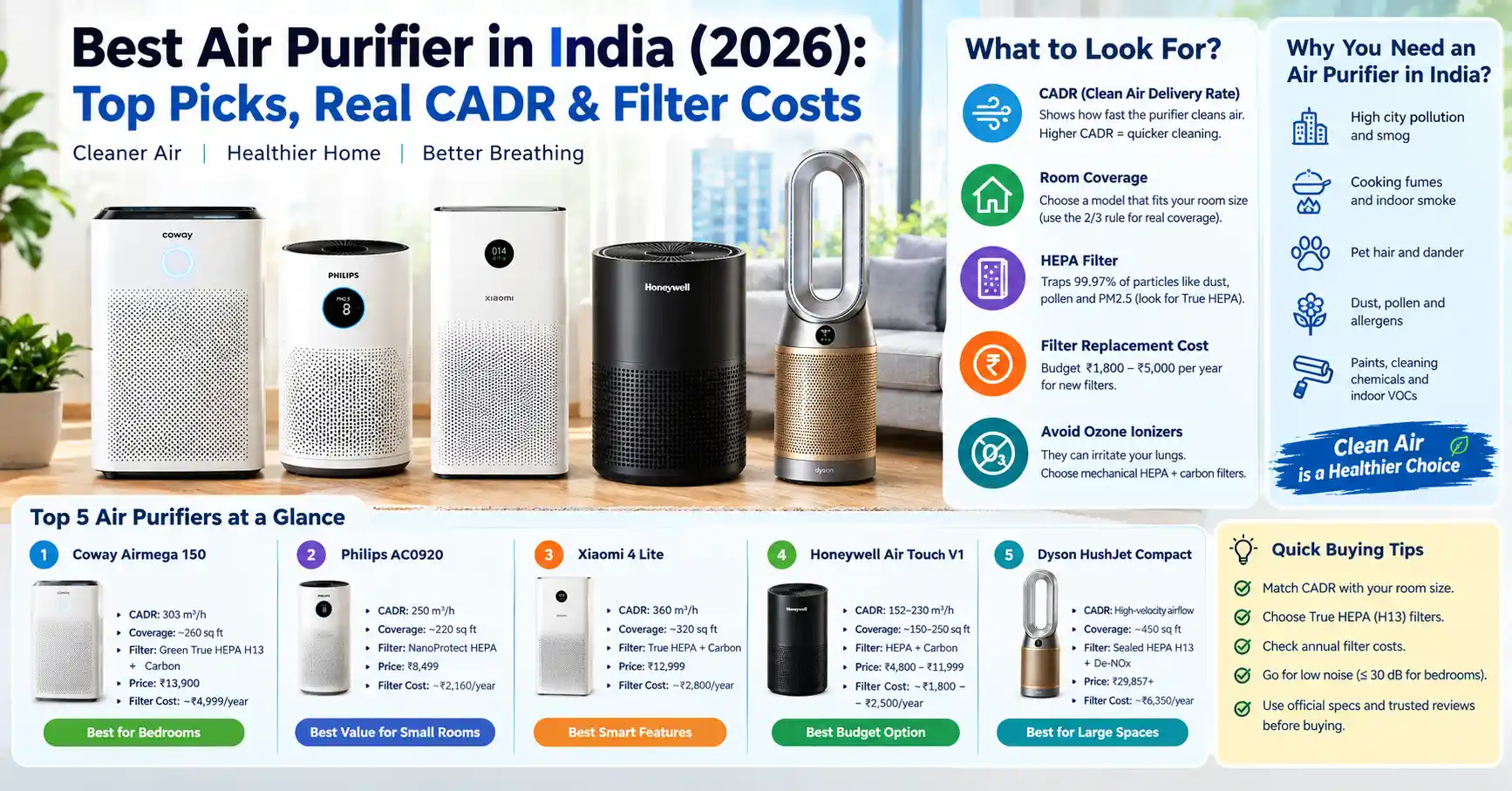
Discover the best air purifier in India (2026) with our top picks, real-world CADR comparisons, room coverage, HEPA filter options, and annual replacement costs to help you choose the right model for your home. For most Indian bedrooms (up to 250 sq ft), the Coway Airmega 150 (AP-1019C) and Philips AC0920 (900 Series) are the best choices. They offer True HEPA H13 filtration, run quietly, and keep filter replacement costs low.
If you want smart app control and a higher CADR (Clean Air Delivery Rate) for medium-to-large rooms (up to 350 sq ft), choose the Xiaomi Smart Air Purifier 4 Lite.
For large living spaces that need fast airflow, special gas filters, and advanced sensors, Dyson purifiers offer top performance.
Key Takeaways
- Trust CADR, Not Box Ratings: Brands often list coverage areas based on ideal conditions. Always look at the Clean Air Delivery Rate (CADR in m³/h) to calculate real room coverage for Indian homes.
- Insist on True HEPA (H13): Make sure your unit has a certified True HEPA H13 filter. It traps 99.97% of fine particles down to 0.3 microns, including PM2.5, dust, and pollen.
- Check Replacement Costs: Air purifiers need new filters over time. Expect to spend ₹1,800 to ₹5,000 every year on replacement filters.
- Clean the Pre-Filter Often: Vacuuming or washing the outer pre-filter every 2–4 weeks helps your main HEPA filter last up to 30% longer.
- Avoid Ozone Ionizers: Ionizers that make ozone can irritate your lungs. Stick to purifiers with mechanical HEPA and activated carbon filters.
Understanding Indoor Air Pollution in Indian Homes
Air pollution in Indian cities reaches unsafe levels, especially in northern regions during winter due to crop burning, traffic fumes, and dust. However, air inside your home can be 2 to 5 times worse than outdoor air. Dust, cooking fumes, incense smoke (agarbatti), pet hair, and paint smells often stay trapped inside rooms.
An air purifier works by pulling room air through multiple filters, trapping dust and smoke, and blowing out clean air. To pick the right model, match the machine’s filtering speed to your room size and local pollution levels.
Top Air Purifiers in India: Detailed Breakdown
1. Coway Airmega 150 (AP-1019C)
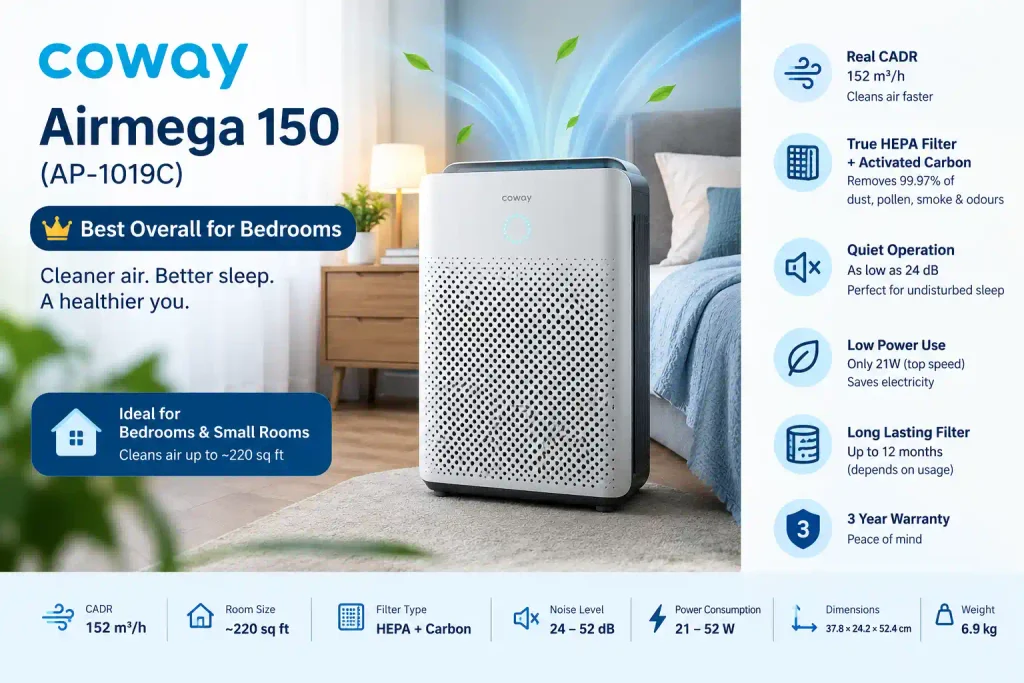
- Ideal Room Size: Up to 250 sq ft (realistic) / 355 sq ft (brand claim)
- CADR: 303 m³/h
- Filter Type: Green True HEPA H13 + Carbon Filter
- Price: ₹13,000 – ₹16,999
- Filter Replacement Cost: ~₹4,500 – ₹4,999
Overview:
The Coway Airmega 150 is popular because of its strong build quality, easy filter changes, and quiet sleep mode. It has a simple color light that shows your room’s air quality. The pre-filter slides out easily from the front, making it simple to wash without touching trapped dirt.
- Pros: Very reliable motor, long filter life (up to 8,500 hours), easy to clean pre-filter.
- Cons: Replacement filters cost more than entry-level models.
2. Philips AC0920 (900 Series)
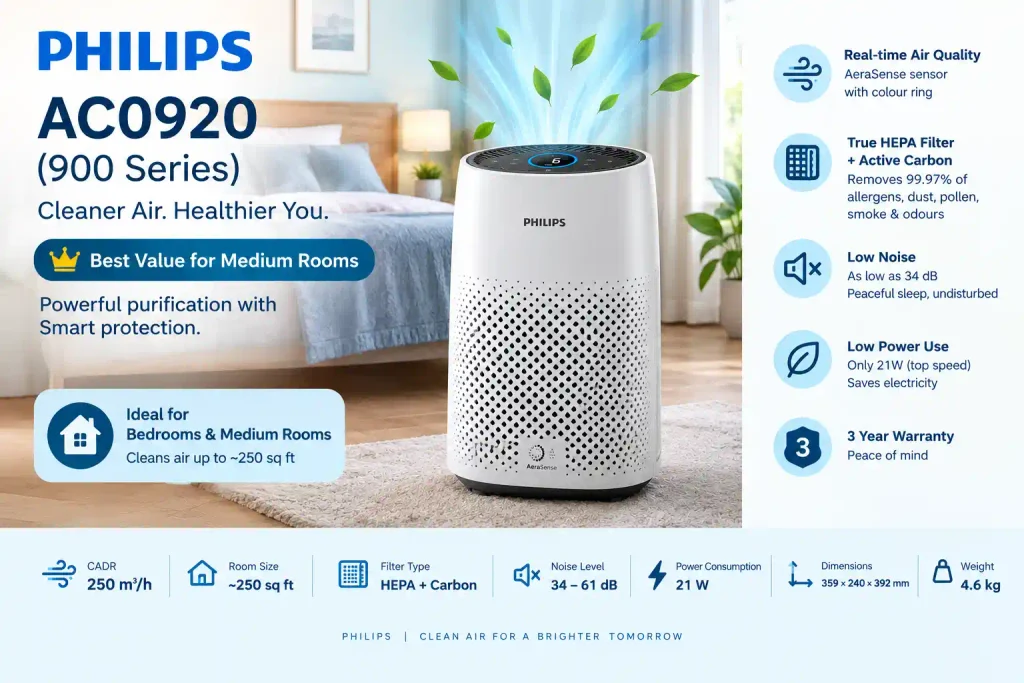
- Ideal Room Size: Up to 220 sq ft (realistic) / 320 sq ft (brand claim)
- CADR: 250 m³/h
- Filter Type: NanoProtect HEPA + Pre-filter
- Price: ₹8,000 – ₹8,500
- Filter Replacement Cost: ~₹2,100 – ₹2,200
Overview:
The Philips AC0920 is a small, power-saving option for compact bedrooms or home offices. It consumes just 21W at maximum fan speed, helping keep electricity costs low while displaying real-time air quality readings.
- Pros: Affordable price, very low power consumption (21W maximum), and budget-friendly running costs.
- Cons: Lacks a thick activated carbon layer for strong chemical or cooking smells.
3. Xiaomi Smart Air Purifier 4 Lite

- Ideal Room Size: Up to 320 sq ft (realistic) / 462 sq ft (brand claim)
- CADR: 360 m³/h
- Filter Type: High-efficiency HEPA + Activated Carbon layer
- Price: ₹12,999
- Filter Replacement Cost: ~₹2,500 – ₹3,000
Overview:
The Xiaomi Air Purifier 4 Lite cleans air quickly at a fair price. It connects easily to the Mi Home app, Google Assistant, and Amazon Alexa. This allows you to control it from your phone, set timers, and monitor PM2.5 levels in real time.
- Pros: Fast cleaning speed for medium rooms, full phone app control, clean design.
- Cons: The boxy design needs open floor space around all four sides to draw in air properly.
4. Honeywell Air Touch V1 / V4 Series

- Ideal Room Size: Up to 150 – 250 sq ft
- CADR: 152 – 230 m³/h
- Filter Type: HEPA + Activated Carbon filter
- Price: ₹4,800 – ₹11,999
- Filter Replacement Cost: ~₹1,800 – ₹2,500
Overview:
Honeywell’s Air Touch models give you an easy way to start cleaning your indoor air. The multi-layer filter removes basic dust, pollen, and pet hair, making it a good fit for smaller rooms and tight budgets.
- Pros: Very affordable starting price, simple button controls, cheap replacement filters.
- Cons: Takes longer to clean air in larger rooms.
5. Dyson Purifier Series (HushJet / Hot+Cool / Big+Quiet)
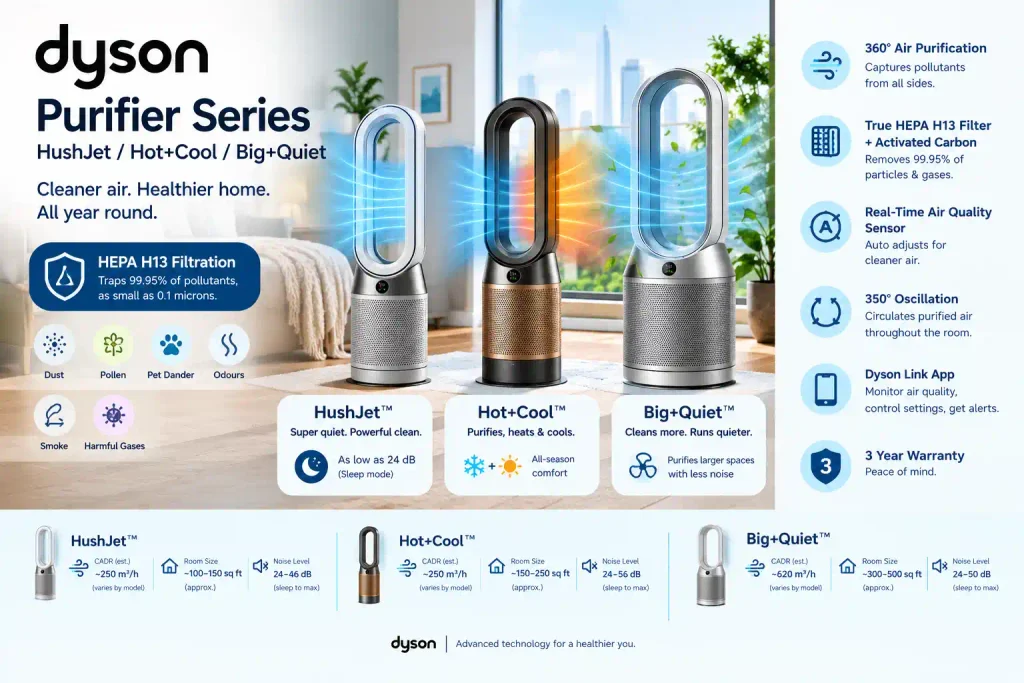
- Ideal Room Size: Up to 600 – 1,000+ sq ft
- CADR: High-velocity circulation design (varies by model)
- Filter Type: Fully sealed HEPA H13 + De-NOx Carbon Filter
- Price: ₹29,800 – ₹68,900+
- Filter Replacement Cost: ~₹6,000 – ₹8,000
Overview:
Dyson purifiers use powerful airflow projection to circulate fresh air across big rooms. Along with standard PM2.5 dust, Dyson filters capture nitrogen dioxide gas, allergens, and odors while acting as a fan.
- Pros: High-end build, fully sealed body prevents dirty air leaks, detailed air reports.
- Cons: High purchase price and expensive replacement filters.
Detailed Spec Comparison Table
| Model | Typical Price (INR) | Rated CADR | Realistic Coverage (2/3 Rule) | Filter Type | Est. Annual Filter Cost |
|---|---|---|---|---|---|
| Honeywell Air Touch V1 | ₹4,839 | 152 m³/h | ~135 sq ft | Composite HEPA + Carbon | ~₹1,800 |
| Philips AC0920 | ₹8,499 | 250 m³/h | ~220 sq ft | NanoProtect HEPA | ~₹2,160 |
| Xiaomi 4 Lite | ₹12,999 | 360 m³/h | ~320 sq ft | True HEPA + Carbon | ~₹2,800 |
| Coway Airmega 150 | ₹13,900 | 303 m³/h | ~260 sq ft | Green True HEPA H13 + Carbon | ~₹4,999 |
| Dyson HushJet Compact | ₹29,857 | Circulating airflow | ~450 sq ft | Sealed HEPA H13 + De-NOx | ~₹6,350 |
Note: Prices and annual filter costs are estimates and may vary by seller and replacement-filter availability. Coverage figures are approximate and depend on ceiling height, room layout, and desired air-cleaning rate. Verify each model’s official CADR and coverage specifications before publishing.
How to Choose an Air Purifier for Indian Homes
1. Understanding CADR and the 2/3 Rule
- CADR (Clean Air Delivery Rate) is measured in cubic meters per hour (m³/h). It shows how fast a purifier filters out smoke, dust, and pollen.
- Brands often rate coverage areas assuming 8-foot ceiling heights and low pollution. But Indian homes usually have 9.5 to 10-foot ceilings, and winter AQI often goes above 300. Use the 2/3 Rule for a realistic room estimate:
- $$\text{Realistic Room Coverage (sq ft)} \approx \text{CADR (m³/h)} \times 0.75$$
Example: A purifier with a 300 m³/h CADR will clean a room up to 225 sq ft during heavy winter pollution.
2. HEPA Filter Grades
Always buy a purifier with a True HEPA H13 filter. Grade H13 HEPA filters trap at least 99.97% of tiny particles as small as 0.3 microns. Avoid terms like “HEPA-type” or “HEPA-like,” as they do not meet official standards.
3. Activated Carbon Layer
A thick activated carbon layer absorbs chemical fumes, volatile gases (VOCs), vehicle smoke (NO2), and bad odors from cooking or tobacco.
4. Noise Levels
If you run your air purifier overnight in your bedroom, check the noise rating on Sleep mode. Choose air purifiers with a noise level of 30 dB or less for a quiet and comfortable night’s sleep.
Total Cost of Running an Air Purifier
When buying an air purifier, keep two main running costs in mind:
- Replacement Filters: In polluted Indian cities, HEPA filters need replacement every 6 to 12 months, depending on usage and local pollution.
- Electricity Bills: Most purifiers use between 20W and 45W on normal fan speeds. Running a 30W purifier all day (24 hours) uses about 0.72 units of electricity per day. That adds about ₹150–₹220 to your monthly electricity bill.
Placement and Maintenance Tips
- Keep Space Around the Unit: Place your purifier 1 to 2 feet away from walls, curtains, and furniture so air can flow into it easily.
- Keep Doors and Windows Closed: Purifiers work like air conditioners. Keeping doors and windows closed prevents fresh pollution from blowing inside.
- Clean the Pre-Filter Regularly: Gently vacuum or wash the outer mesh pre-filter every 2–3 weeks to remove hair and large dust particles. Never wash the inner HEPA filter with water.
- Raise It Off the Floor: Placing your purifier 1–2 feet above the ground on a table or stool helps it catch floating dust before it lands on the floor.
READ ALSO: Best Battery Backup Phone Under 15000 in India (2026):
Frequently Asked Questions
Q1: Is an air purifier necessary for Indian homes?
Yes. Cities across India face high PM2.5 levels throughout the year from dust, construction, and traffic, with extreme spikes in winter. Indoor air purifiers significantly lower fine dust, pollen, and allergens inside your rooms.
Q2: How long do HEPA filters last in India?
In most Indian cities, a HEPA filter lasts between 6 to 12 months. In areas with extreme winter pollution (like Delhi-NCR), you may need to replace the filter sooner if you run it constantly.
Q3: Can I wash a HEPA filter to reuse it?
No. Standard HEPA filters are made of delicate fibers that break down when scrubbed or exposed to water. Washing a HEPA filter ruins its fine mesh, stopping it from catching PM2.5 dust. You should only wash the outer plastic pre-filter mesh.
Q4: Is it safe to run an air purifier throughout the night?
Yes. Running your air purifier on Sleep or Auto mode overnight keeps PM2.5 levels low while you sleep. This helps reduce morning nasal congestion and improves sleep quality.
Q5: Does an air purifier remove room dust?
An air purifier captures light dust floating in the air. However, it cannot pull heavy dust particles off your floor, bedsheets, or tables. Regular sweeping and dusting are still necessary.
Q6: What is CADR in an air purifier?
CADR stands for Clean Air Delivery Rate. It measures how much clean, filtered air the machine pushes out at top speed (in m³/h or CFM).A higher CADR rating means the air purifier cleans the room’s air faster.
Q7: Are ionizer air purifiers safe for children and elderly people?
Purifiers using mechanical HEPA and carbon filters are the safest. Some ionizer models produce small amounts of ozone, which can irritate sensitive lungs, asthmatics, and infants. If your purifier has an ionizer, make sure you can turn it off.
Q8: What is the maximum room size suitable for an air purifier with a 300 m³/h CADR?
Considering Indian ceiling heights and heavy air pollution, a 300 m³/h CADR purifier cleans a room size of about 200 to 250 sq ft effectively.
1 thought on “Best Air Purifier in India (2026): Top Picks, Real CADR & Filter Costs”