
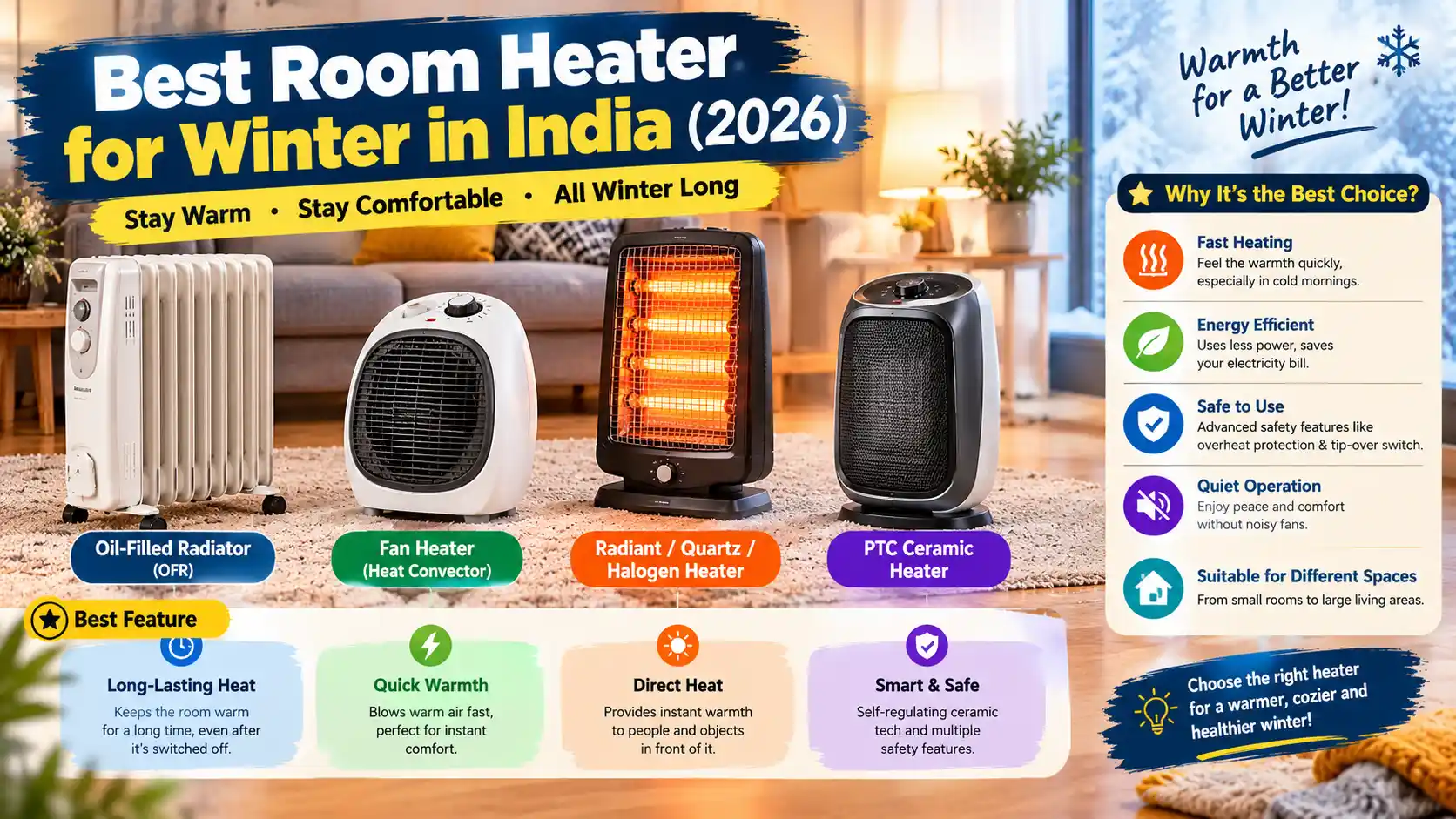
Choosing the best room heater for winter in India depends on four key factors: how quickly it heats the room, electricity consumption, room size, and safety and comfort features. During cold winters in North, Central, and East India, choosing the wrong heater can lead to high power bills, dry skin, or poor heating in brick-and-concrete rooms.
This guide covers the top room heaters in India for 2026. It compares key heating technologies—Oil-Filled Radiators (OFR), Fan Convectors, Radiant Rods, and PTC Ceramic heaters—and shows you how to calculate your daily electricity costs in Indian Rupees (₹).
Quick Selection Guide: Best Room Heaters in India (2026)
| Heater Category | Recommended Model | Wattage / Specifications | Ideal Room Size | Key Advantage | Approx. Price |
|---|---|---|---|---|---|
| Best Overall (OFR) | Havells Hestio 11/13 Fin OFR | 2,900W (2,500W + 400W PTC) | Up to 250 sq. ft. | Long-lasting, quiet heat | ₹11,000–₹13,500 |
| Best Budget OFR | Morphy Richards OFR 09 Fin | 2,000W | Up to 150 sq. ft. | Consistent heat and auto cut-off | ₹7,000–₹8,000 |
| Best Fan / Blower | Orpat OEH-1220 / 1260 | 1,000W / 2,000W | Up to 120 sq. ft. | Quick heating at a low price | ₹1,100–₹1,500 |
| Best Personal / Low-Power Heater | Orient Electric Stark Quartz | 400W / 800W | Personal spot heating | Low power consumption | ₹1,000–₹1,300 |
| Best PTC Ceramic | Morphy Richards Aristo PTC | 2,000W | Up to 150 sq. ft. | Ceramic heating with automatic temperature control | ₹3,000–₹4,000 |
Note: Prices, specifications, and recommended room sizes are approximate and may vary by model and seller. Check the manufacturer’s specifications before purchasing. Oil-filled radiators do not consume oxygen during normal operation, but no room heater should be described as keeping oxygen levels high or guaranteeing a particular humidity level.
Key Takeaways
- For Bedrooms & Babies: Oil-Filled Radiators (OFR) are best because they do not burn oxygen or dry out the air.
- For Fast Heating: Fan heaters warm you up quickly, but they make fan noise and lower room moisture.
- For budget-conscious buyers and personal use, quartz and halogen heaters are affordable options, typically using 400W–800W of power. They work best when you sit right in front of them.
- Socket Safety: Heaters rated above 1500W must use a 15-Ampere (15A) wall plug to prevent melted plugs or electrical short circuits.
Understanding Room Heater Types in India
Before buying a room heater, understand how each type works, its main benefits, and its limitations.
| Room Heater Type | Key Advantages | Limitations | Best For |
|---|---|---|---|
| Oil-Filled Radiator (OFR) | Quiet operation, provides steady heat after warming up | Higher purchase price, slower initial heating | Bedrooms and longer heating sessions |
| Fan / Blower Heater | Heats nearby spaces quickly, lightweight and portable | Fan noise, may make the air feel drier | Small rooms and quick warmth |
| Radiant / Quartz / Halogen Heater | Affordable, directs heat towards people, often has lower-power settings | Limited heating range, exposed elements can become very hot | Personal use and spot heating |
| PTC Ceramic Heater | Quick warmth, compact design, often includes thermostat control | Fan noise on blower models, power use depends on wattage | Small rooms, desks, and personal spaces |
Buying tip: Choose an OFR for quiet, sustained heating; a fan heater for quick warmth; a radiant heater for personal use; or a ceramic heater for compact convenience. Always check safety features, power consumption, and the manufacturer’s recommended room size.
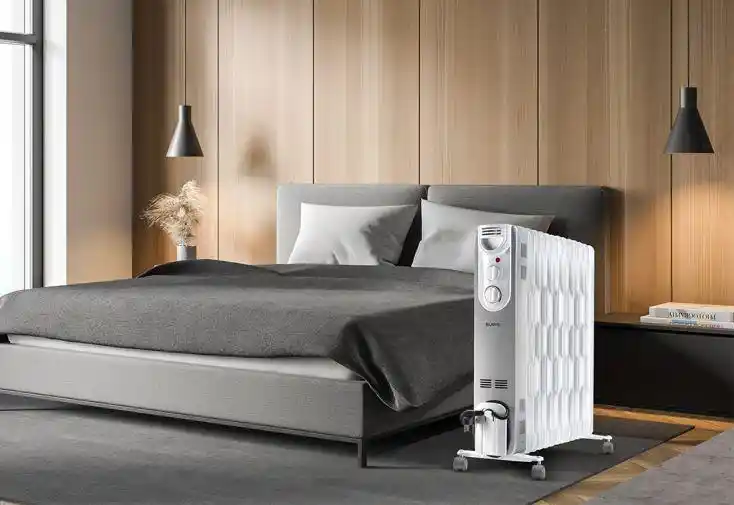
- Long-Lasting Heat: The heated oil retains warmth, helping the room stay warm for a while after the heating element switches off.
- Silent Operation: OFR heaters do not need a fan, so they operate quietly and are suitable for bedrooms, study rooms, and workspaces.
- Even Heat Distribution: Warm air gradually circulates around the room, providing more consistent heating than a radiant heater directed at one spot.
- No Fuel Combustion: The sealed oil is heated electrically, so the heater does not burn fuel or consume oxygen during normal operation.
- Thermostat Control: Many models let you adjust the temperature and automatically cycle the heating element to maintain the selected setting.
- Safety Features: Room Heater Depending on the model, features may include overheat protection, a thermostat, and a tip-over switch.
2. Fan Heaters (Heat Convectors)
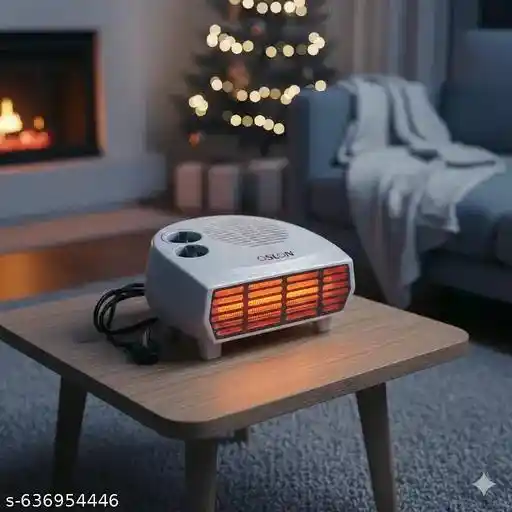
- Fast Heating: The fan pushes warm air into the surrounding area, helping you feel warmer quickly after switching on the heater.
- Compact and Portable: Most fan heaters are lightweight and easy to move between rooms.
- Budget-Friendly: Basic models are usually cheaper than oil-filled radiators, making them suitable for buyers with limited budgets.
- Adjustable Heat Settings: Many models offer 1,000W and 2,000W settings, allowing you to choose the heating level according to your needs.
- Thermostat Control: Some models include a thermostat that switches the heating element on and off to help maintain a comfortable temperature.
- Suitable for Small Spaces: Fan heaters work well for personal heating, small bedrooms, and study areas when used according to the manufacturer’s room-size guidance.
3. Radiant / Quartz / Halogen Heaters

- Instant Direct Warmth: The glowing heating rods provide warmth as soon as you switch on the heater, making them useful during cold mornings and evenings.
- Low-Power Settings: Many models offer settings such as 400W and 800W, while some higher-powered models can use 1,200W or more.
- Affordable Price: Quartz and halogen heaters are generally budget-friendly, making them suitable for students and households looking for economical heating options.
- Quiet Operation: Most radiant heaters work without a fan, so they produce very little operating noise.
- Compact and Lightweight: Their small size makes them easy to place near a desk or seating area, provided the required safety clearance is maintained.
- Adjustable Heat Levels: Depending on the model, you may be able to select different power settings to control warmth and electricity consumption.
- Protective Safety Grill: Many models include a front grill to reduce direct contact with the heating rods, although the grill itself can become hot.
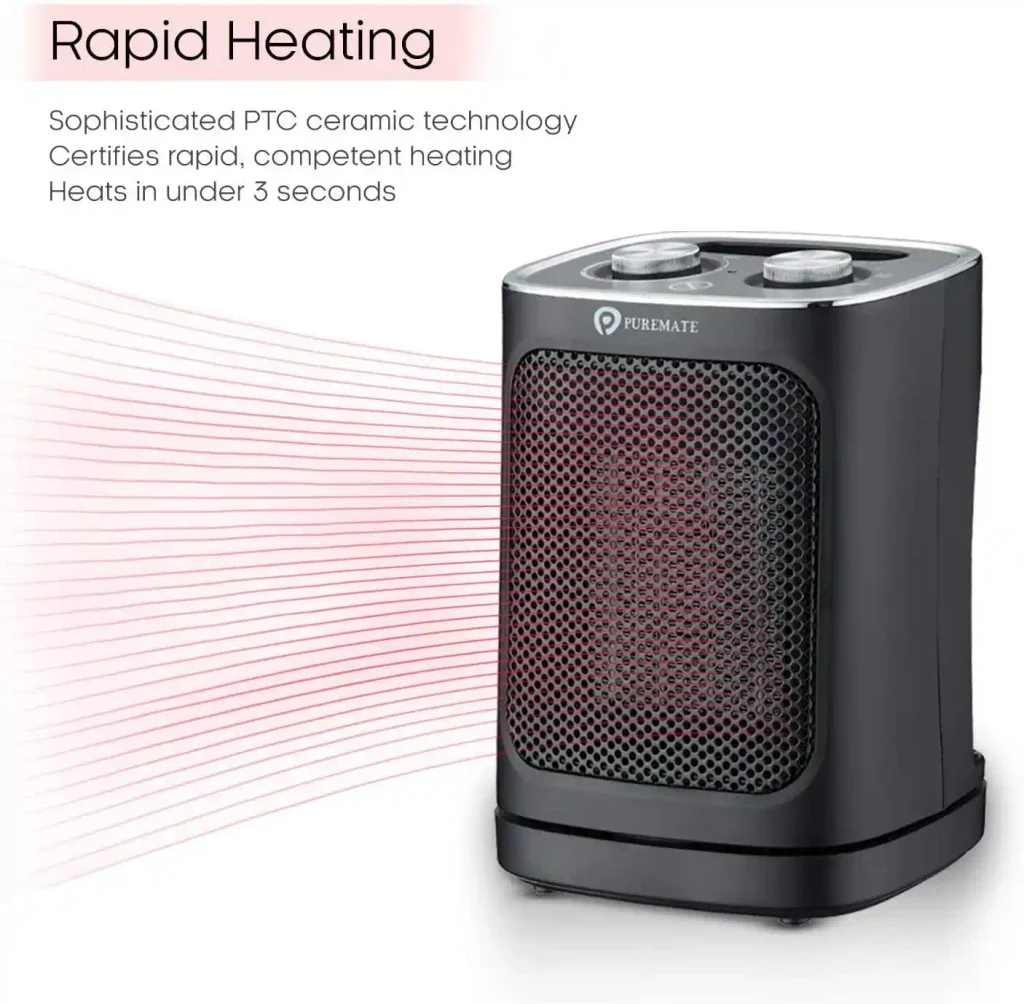
- Quick Heating: Ceramic elements heat up quickly, while the built-in fan distributes warm air to help you feel comfortable sooner.
- Self-Regulating Heating Element: PTC ceramic technology increases electrical resistance as the element gets hotter, helping limit further temperature rise.
- Compact Design: Most models are lightweight and easy to place in a study room, office, or small bedroom.
- Adjustable Heat Settings: Many heaters offer multiple power modes, such as 1,000W and 2,000W, to suit different heating needs.
- Thermostat Control: Selected models allow you to set a target temperature and automatically cycle the heating element to maintain it.
- Built-In Safety Features: Room Heater Depending on the model, protection may include overheating cut-off and a tip-over switch.
- Fan-Assisted Airflow: The fan spreads warm air beyond the immediate front of the heater, making it useful for personal heating and small spaces
Matching Room Size to Wattage
Using a small room heater in a big room forces it to run on high power all the time. This raises your power bill without heating the room well. Use this size guide for standard 9-to-10-foot ceiling heights in Indian homes:
| Room Dimensions | Total Area (Sq Ft) | Recommended Heater Type | Recommended Power Rating |
| Up to 8 x 10 ft | Up to 80 sq ft | Quartz / Carbon Tube / Small Fan | 800W – 1000W |
| Up to 10 x 12 ft | 100 – 120 sq ft | Fan Convector / 7-Fin OFR / PTC | 1200W – 2000W |
| Up to 12 x 15 ft | 140 – 180 sq ft | 9-Fin or 11-Fin OFR / 2000W Fan | 2000W – 2400W |
| Up to 15 x 20 ft | 200 – 300 sq ft | 11-Fin or 13-Fin OFR with PTC fan | 2500W – 2900W |
How to Calculate Room Heater Electricity Costs
You can estimate your room heater’s electricity bill by calculating its power consumption and multiplying the units used by your electricity rate.
Electricity Cost Formula
- Units used (kWh) = Wattage × Hours used ÷ 1,000
- Daily cost (₹) = Units used × Electricity rate per unit
Examples for Indian Homes
Assuming an electricity rate of ₹7.50 per unit:
| Heater Type | Wattage | Daily Usage | Units Used per Day | Daily Cost | Monthly Cost (30 Days) |
|---|---|---|---|---|---|
| Fan Heater | 2,000W | 4 hours | 8 units | ₹60 | ₹1,800 |
| Quartz Heater | 800W | 4 hours | 3.2 units | ₹24 | ₹720 |
| Oil-Filled Radiator (OFR)* | 2,500W | 3.6 active hours | 9 units | ₹67.50 | ₹2,025 |
*The OFR example assumes 6 hours of use, with the heating element actively drawing full power for 60% of that time due to thermostat cycling.
Important Things to Remember
- Actual costs vary: Your electricity tariff depends on your state, consumption slab, and applicable charges.
- Thermostats affect consumption: Heaters that cycle on and off may use less electricity than their maximum rated power suggests.
- Lower wattage generally means lower running costs: However, it may also provide less heat.
- Monthly estimates assume daily use: Your actual bill will depend on how many days and hours you operate the heater.
Tip: Before buying a room heater, compare both its purchase price and estimated running cost to choose one that suits your winter budget.
Health & Safety Tips for Indian Homes
Keep these points in mind when running space heaters in winter:
- Air Quality and Dryness: Fan and rod heaters can circulate dust and make the air feel drier by reducing relative humidity, especially in poorly ventilated rooms. This causes dry eyes, chapped skin, and throat irritation. If you use a fan heater, place a bowl of water in the room to keep moisture in the air.
- Overnight Use: Never leave open-wire or rod heaters running unattended while you sleep. Only thermostat-controlled Oil-Filled Radiators with auto cut-off switches are safe for overnight use.
- Power Socket Safety: Always plug heaters rated above 1500W directly into a 15A heavy-duty wall socket. Light 6A extension boards can melt or spark from wire overheating.
- BIS / ISI Certification: For safer home use, choose a room heater with a valid ISI mark that meets the applicable Bureau of Indian Standards (BIS) safety requirements.
READ ALSO:Best Budget Monitors Under ₹5,000 in India:
Frequently Asked Questions
Q1. Which type of room heater is best for health?
Answer: Oil-Filled Radiators (OFR) are the healthiest option. OFRs heat liquid oil inside sealed fins without burning exposed heating coils in open air. This keeps normal oxygen and air moisture levels intact. It prevents dry skin, throat irritation, and breathing issues, making OFRs safe for infants, seniors, and asthma patients.
Q2. Which room heater uses the least electricity in India?
Answer: Quartz and halogen rod heaters use the least electricity (400W to 800W). However, they only heat objects directly in front of them. For heating an entire bedroom efficiently, an Oil-Filled Radiator with an adjustable thermostat works best over long hours because it automatically cuts off power once the room is warm.
Q3. Can we use a room heater overnight in a closed room?
Answer: Running open-wire fan heaters or radiant rod heaters overnight in a closed room is unsafe. They drop oxygen levels, dry out the air, and pose a fire hazard. Only Oil-Filled Radiators with working thermostats, auto cut-off features, and tilt safety switches are safe for overnight sleeping.
Q4. What heater wattage do I need for a 150 sq ft room?
Answer: A 150 sq ft bedroom needs a 2000-Watt fan or PTC ceramic heater, or a 9-Fin to 11-Fin Oil-Filled Radiator (2000W–2400W). This power rating handles typical brick-and-concrete Indian walls easily.
Q5. Why does my extension cord melt when using a room heater?
Answer: Most basic home extension boards in India are built for light 6-Ampere loads (up to 1300 Watts). Heavy room heaters draw 2000 to 2900 Watts. This overload overheats thin extension wires, leading to melted plugs and short circuits. Always plug heavy heaters directly into a dedicated 15A wall socket.
1 thought on “Best Room Heater for Winter in India (2026):”